Some sports careers are easy to summarize. There is a young athlete, a few major competitions, a medal or two, and eventually retirement. But when you look closer, the real story is usually much bigger than the results printed in a record book.
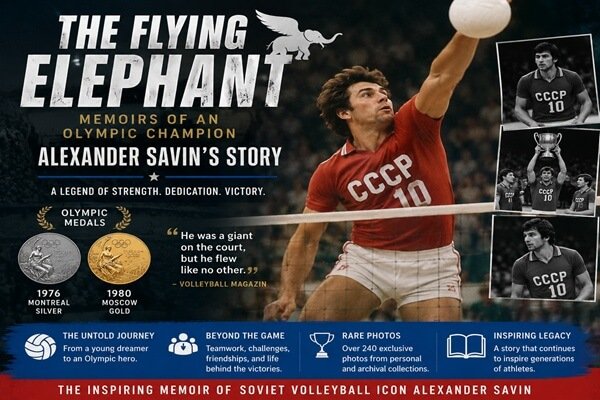
The Flying Elephant Memoirs of an Olympic Champion: Alexander Savin’s Story is interesting for exactly that reason. The book takes readers into the world of Alexander Savin, a Soviet volleyball player whose career reached its highest point at the Olympic Games. Savin won silver at the 1976 Montreal Olympics and four years later became an Olympic champion with the Soviet team at the 1980 Moscow Games.
For someone who only knows Savin as a name on an Olympic medal list, the memoir offers something different. It puts the athlete, the volleyball court, the team environment and the sporting era into a much wider story.
The title itself is enough to make you stop for a second.
Why call the book The Flying Elephant?
The answer becomes easier to understand when you look at Savin’s reputation as a large and powerful volleyball player who was also known for his remarkable movement and jumping ability. A contemporary Washington Post article, quoting Volleyball Magazine from 1978, described Savin as an exceptionally large athlete who had remarkable “air time” as a leaper.
That unusual combination of size, power and movement helped make the nickname memorable.
But the story behind The Flying Elephant Memoirs of an Olympic Champion goes beyond a nickname. It is a story about an athlete who competed at a time when Soviet volleyball was one of the major forces in international sport.
Who Was Alexander Savin?
Alexander Savin was a Soviet volleyball player who competed internationally during the 1970s and 1980s.
He played as a middle blocker and represented both the Soviet national team and CSKA Moscow. His international career included two Olympic medals: silver at Montreal in 1976 and gold at Moscow in 1980.
Those two Olympics tell an important part of his story.
Montreal was the near miss.
Moscow was the triumph.
The Soviet team finished second in Montreal after losing the final to Poland. A historical account of Olympic volleyball notes that the Soviet team in Montreal included Savin and finished with the silver medal after a five-set final.
Four years later, the situation was very different.
The 1980 Olympic Games were held in Moscow, and Savin was part of the Soviet team that won the gold medal. The Moscow tournament also took place during a major political period in Olympic history, with a large number of countries absent because of the boycott.
That background gives Alexander Savin’s Story a much stronger historical setting than a simple sports biography.
Why The Flying Elephant Is an Unusual Title
At first, the words “flying elephant” sound almost like a joke.
Elephants are associated with weight, strength and size. Flying suggests lightness, speed and something almost impossible.
Put those two ideas together and you get a useful description of a volleyball player who combined physical power with exceptional movement around the net.
Savin’s size was part of his identity as a player, but being big is not enough to become an elite volleyball athlete. Volleyball requires timing, coordination, positioning, jumping ability and the ability to react quickly.
A powerful player who cannot move effectively is easy to exploit.
Savin’s reputation was different.
The historical descriptions of his playing style emphasize both his physical presence and his ability to get into the air quickly. The German volleyball publication Volleyball Magazin describes him as a two-meter player and highlights his movement, anticipation and attacking ability.
That contrast explains why the nickname works so well.
The “elephant” represents the physical power.
The “flying” represents what Savin could do with that body on a volleyball court.
The Olympic Journey Makes the Memoir More Interesting
One of the strongest reasons to look at The Flying Elephant Memoirs of an Olympic Champion: Alexander Savin’s Story is the progression from 1976 to 1980.
Winning an Olympic medal is already a huge achievement.
But Savin did not begin his Olympic story with gold.
He began with silver.
The Soviet team entered the 1976 Montreal Olympics as one of the major volleyball powers. The final against Poland was closely contested, but Poland won 3–2 and took the gold medal. The Soviet team, which included Savin, finished second.
Four years later, Savin had another opportunity.
This time, the Soviet team won gold in Moscow.
That creates a natural human story: disappointment followed by another chance.
It is easy to talk about resilience when everything works out.
It is more interesting when an athlete has experienced both sides.
Savin knew what it felt like to reach an Olympic final and lose.
He also knew what it felt like to return to the Olympic stage and win.
Montreal 1976: The Silver Medal
The 1976 Olympics are an important part of understanding Alexander Savin.
The Soviet team reached the final against Poland, and the match went the full five sets. Poland eventually won, leaving the Soviet side with silver.
For the public, the result was straightforward.
Poland won.
The Soviet Union finished second.
But athletes experience results differently.
A silver medal can mean pride and disappointment at the same time.
You are an Olympic medalist.
You have competed among the best athletes in the world.
Yet you also know that you were one match away from gold.
That combination is important when thinking about Savin’s later Olympic success.
The 1980 gold medal did not come from nowhere.
It came after years of experience, including the disappointment of Montreal.
Moscow 1980: Becoming an Olympic Champion
The 1980 Moscow Olympics became the defining Olympic moment of Savin’s career.
The Soviet team won the men’s volleyball gold medal on home soil. Savin was part of that championship team. Olympic records and historical volleyball sources identify him among the Soviet players who won gold in Moscow.
The setting itself was extraordinary.
The Olympics were taking place in the Soviet Union.
International politics were heavily influencing the Games.
Many countries, including the United States, did not participate because of the boycott.
That meant the tournament existed inside a much larger political story.
For athletes, however, the focus still had to return to the court.
A volleyball player cannot spend a match thinking about geopolitics.
The serve is coming.
The block has to be formed.
The attack has to be timed.
The next point has to be played.
That is one of the fascinating things about Olympic sport during politically tense periods. Athletes can become symbols of much larger events while still having to perform one point at a time.
Savin Was More Than an Olympic Medalist
It would be easy to build an article about Alexander Savin around his Olympic medals.
Silver in 1976.
Gold in 1980.
Done.
But that would leave out much of what makes his career interesting.
Savin was part of a Soviet volleyball generation that achieved major international success. A volleyball history source credits him with two World Championship titles, six European Championship titles and the 1980 Olympic title.
Those achievements place him in a much larger story.
He wasn’t simply an athlete who happened to win one Olympic tournament.
He was part of a highly successful national volleyball program and competed for years at the highest international level.
That makes his memoir useful for readers who want to understand how elite volleyball looked during that period.
The Soviet Volleyball Era
To understand Alexander Savin The Flying Elephant Memoirs of an Olympic Champion, it helps to understand the sporting environment around him.
Soviet sport was highly organized and competitive.
International success mattered.
Athletes were expected to train hard, follow coaching systems and perform as part of a larger team.
Volleyball was one of the sports in which the Soviet Union became a major international power.
Savin’s career developed within that environment.
He was not playing in today’s professional sports world, where social media, personal branding and global sponsorships are central parts of an athlete’s life.
The world was different.
International travel was different.
Media coverage was different.
The relationship between sport and national identity was different.
That makes the memoir more than an athlete’s personal story.
It can also be read as a window into a particular period of sports history.
What Makes a Sports Memoir Different?
A biography tells you about a person.
A memoir gives you the person’s perspective.
That distinction matters.
A statistics page can tell you that Savin won an Olympic gold medal.
A newspaper can describe a match.
A historical database can list his teams.
But a memoir can explore what it meant to live through those experiences.
That’s why readers searching for The Flying Elephant Memoirs of an Olympic Champion: Alexander Savin’s Story are likely looking for something different from an ordinary Olympic results page.
They want the story behind the result.
They want to know about the athlete rather than just the medal.
They want context.
And they want to understand why the career mattered.
The Human Side of Elite Sport
Elite athletes often look different from ordinary people when we see them competing.
They appear confident.
They look prepared.
They seem to know exactly what they’re doing.
But the competition itself is only the visible part of the process.
Behind it are training sessions, repetition, travel, coaching, injuries, pressure and competition for places on a team.
Volleyball adds another layer because individual performance is tied directly to teammates.
A middle blocker cannot simply decide to play their own game.
They have to read the setter.
They have to understand the opponent.
They have to communicate with teammates.
They have to react quickly.
The team’s success depends on many small decisions happening almost simultaneously.
That is why a volleyball memoir can be interesting even to someone who isn’t a serious volleyball follower.
The sport provides the setting.
The human experience is much wider.
Also Read: JusTalk Kids Guide: Safe Video Calling, Messaging, Features, and Parent Controls
Why Teamwork Matters So Much
Volleyball is one of the clearest examples of a sport where individual talent is not enough.
A great attacker needs a good set.
A good setter needs players who can finish the attack.
A strong blocker needs teammates who understand the defensive system.
A defender needs the rest of the team to turn a save into an attack.
Everything connects.
Savin’s career therefore cannot be understood only as an individual achievement.
The Olympic gold medal belongs to a team.
The same is true of the major international titles he won with the Soviet national side.
That is an important lesson for anyone reading the book from outside volleyball.
Success often looks individual from the outside.
In reality, it usually depends on a network of people.
The Role of the Coach
A great athlete still needs coaching.
Coaches identify weaknesses.
They adjust tactics.
They demand consistency.
They decide roles.
They also have to understand personalities.
A player may be physically ready but mentally distracted.
Another player may need confidence.
Someone else may need more discipline.
The relationship between coach and athlete becomes especially important at international level.
Historical material about Savin describes coach Vyacheslav Platonov speaking highly of his movement and ability to anticipate teammates and opponents.
That kind of relationship is interesting because it shows how an athlete’s talent is developed within a system.
Raw ability is only the beginning.
The Meaning of Discipline
People often describe Olympic champions as naturally gifted.
That is only part of the story.
Natural ability can give an athlete an advantage.
It cannot replace preparation.
Volleyball players repeat the same basic movements thousands of times.
They practice their approach.
They practice blocking.
They work on timing.
They study opponents.
They develop physical strength.
They improve coordination.
They play matches.
Then they do it again.
That repetition is not glamorous.
It is one of the foundations of elite sport.
A memoir about a champion becomes valuable when it helps readers understand that side of achievement.
The medal is visible.
The discipline that produced it is mostly invisible.
Learning From the 1976 Loss
Perhaps one of the most relatable parts of Savin’s Olympic story is that he did not win the first time.
The 1976 final ended with the Soviet Union losing to Poland.
Four years later, Savin was an Olympic champion.
That doesn’t mean every failure automatically turns into success.
Real life doesn’t work that neatly.
But it demonstrates something important: losing one major competition does not necessarily define an athlete’s career.
A disappointing result can become part of a longer journey.
The key is what happens afterward.
Do you stop?
Do you change?
Do you learn?
Do you keep competing?
For Savin, the story continued.
Why the 1980 Victory Had Extra Meaning
Winning an Olympic gold medal is special anywhere.
Winning in your home country can create another level of expectation.
The Moscow Games were held in the Soviet Union, and the political situation surrounding them was unusual.
The boycott meant that many major sporting nations were absent.
That doesn’t erase the athletic achievement.
It does provide context.
The Soviet players were competing under enormous expectations in front of a home audience.
For Savin, the Olympic gold became the defining result of a career that had already included an Olympic silver medal.
That contrast makes his Olympic story especially easy to follow.
Why the Book Matters to Volleyball Fans
For volleyball fans, the biggest attraction is obvious.
Savin belonged to a generation of players who helped establish Soviet volleyball as a major force.
The historical record describes him as one of the outstanding players of his era. Volleyball Magazin even compares his importance to volleyball with the stature of Pelé in football.
Whether you agree with such a comparison or not, it shows how highly he was regarded.
A memoir allows modern readers to revisit that era through the perspective of someone who was actually on the court.
That is valuable because sporting memories disappear surprisingly quickly.
Players retire.
Matches become old footage.
Teams change.
New generations grow up without knowing the stars of previous decades.
Books preserve those stories.
The Photographs Add Another Layer
One of the most frequently reported features of the English edition is its collection of photographs.
Current descriptions of the Kindle edition say it contains more than 240 photographs drawn from family and archival material.
That is a significant addition to a sports memoir.
Photographs can show things that words cannot fully recreate.
They can show the uniforms used during a particular period.
They can show teammates.
They can show training environments.
They can show Olympic venues.
They can show how the sport looked decades ago.
For younger volleyball fans, these images can make the history feel much more immediate.
The Kindle Edition
The The Flying Elephant Memoirs of an Olympic Champion Kindle Edition Alexander Savin is especially relevant for readers who prefer digital books.
Current online descriptions report a Kindle edition of around 514 pages and more than 240 photographs. Some listings also report features such as enhanced typesetting and Page Flip.
Because Kindle editions can differ by marketplace, readers should check the current Amazon listing for their country before purchasing.
Price, availability, subscription eligibility and technical details can change.
One practical point is worth considering: if photographs are an important reason for reading the book, a tablet or larger screen may provide a better experience than a small e-reader.
Is The Flying Elephant Available on Amazon Kindle?
Current web sources describe an English Kindle edition of The Flying Elephant: Memoirs of an Olympic Champion.
Readers searching for The Flying Elephant Memoirs of an Olympic Champion Amazon Kindle or The Flying Elephant Memoirs of an Olympic Champion Kindle Edition Amazon should search the exact title together with Alexander Savin.
Always check the author name and edition before buying.
That is especially important with older sports subjects because similarly titled books or unrelated results can sometimes appear in search.
The English Translation
The English-language edition also has an interesting background.
Translator Alfredo Cabero has written about helping translate Savin’s memoirs from Russian into English, describing the project as an opportunity to work on the memoirs of an athlete he admired.
Current descriptions also identify Savin’s brother, Andrei Savine, as being involved in the English edition, along with Julia Savine and other contributors.
That family involvement is worth noting because translating a memoir is different from translating a technical document.
The translator has to preserve the personality of the writing.
Sporting terms have to make sense.
Cultural references have to remain understandable.
The result needs to sound natural in English without losing the original perspective.
Why Translation Opens the Story to New Readers
For many English-speaking readers, Soviet volleyball is not a familiar subject.
They may know the Olympics.
They may know the Cold War.
They may know a few famous sports stories.
But they may not know the athletes who competed in volleyball during that period.
An English edition makes those experiences accessible to a new audience.
That gives the book value beyond its original language.
It becomes a bridge between a historic sporting culture and modern readers.
What Can Non-Volleyball Readers Get From the Book?
You don’t need to understand every volleyball tactic to appreciate an athlete’s story.
The bigger subjects are easy to understand.
Pressure.
Competition.
Failure.
Teamwork.
Discipline.
Ambition.
Leadership.
Achievement.
These ideas exist outside sport.
A student preparing for an important exam understands pressure.
A business owner understands competition.
A musician understands repetition.
A professional understands the need to perform consistently.
The setting is volleyball, but the underlying questions are universal.
The Cost of Becoming an Elite Athlete
One of the most interesting questions any sports memoir can raise is the cost of excellence.
What does an athlete give up?
Free time?
Normal routines?
Family time?
Comfort?
Privacy?
A normal career?
There is no single answer for every athlete.
But reaching the Olympic level requires an extraordinary amount of commitment.
The public usually sees the result.
The athlete lives the process.
That difference is one of the reasons memoirs can be so valuable.
They remind us that the podium is the final visible point of a much longer journey.
Success Is Not Only About Talent
A talented athlete who refuses to train will not reach the highest level.
A hard-working athlete without enough ability may also struggle.
Elite success usually requires several things working together.
Talent.
Training.
Coaching.
Opportunity.
Health.
Teamwork.
Mental strength.
Timing.
Savin’s career provides a real example of that combination.
His physical qualities made him an unusual player.
His training and experience turned those qualities into elite performance.
His teammates and coaches were part of the system.
And the Olympic stage provided the opportunity to prove it.
Why Savin’s Story Remains Relevant
The sporting world has changed dramatically since Savin’s Olympic career.
Modern volleyball is faster.
Technology is more advanced.
Athletes have access to video analysis, sports science and training methods that previous generations did not have in the same form.
Yet the basic demands remain.
You still need discipline.
You still need timing.
You still need teamwork.
You still need the ability to handle pressure.
You still have to perform when the match matters most.
That’s why an older sports story can still feel relevant.
The environment changes.
The human challenge remains.
The Flying Elephant as a Symbol of Athletic Excellence
There is another way to understand the title.
An Olympic athlete is expected to do things that ordinary people cannot do.
Run faster.
Jump higher.
Lift more.
React quicker.
Maintain focus under pressure.
Perform when millions of people are watching.
The flying elephant captures that feeling.
Something that looks physically unlikely becomes possible through training and athletic ability.
Savin’s career makes the metaphor especially fitting because his reputation combined physical strength with exceptional jumping and movement.
The title therefore isn’t just memorable.
It reflects something about the athlete himself.
A Book About an Era, Not Just a Person
One of the strongest reasons to read The Flying Elephant Memoirs of an Olympic Champion: Alexander Savin’s Story is the historical setting.
Savin’s career passed through an important period in international sport.
The Cold War shaped international competition.
The Olympics became a stage where national prestige mattered.
Soviet sports programs were highly competitive.
International volleyball was developing rapidly.
Savin was there for a significant part of that story.
That means his memoir can be read on two levels.
The first is personal.
What happened to Alexander Savin?
The second is historical.
What was international volleyball like during his generation?
That combination gives the book more lasting value.
Who Should Read The Flying Elephant?
The obvious audience is volleyball fans.
But I would not stop there.
The book may also appeal to:
Olympic fans who enjoy stories behind famous competitions.
Sports historians interested in Soviet-era international competition.
Volleyball coaches looking for historical perspectives on elite players.
Athletes interested in the mindset and demands of high-level competition.
Memoir readers who enjoy real-life achievement stories.
Cold War history readers interested in the connection between politics and international sport.
General readers who enjoy stories about discipline and ambition.
You don’t need to be able to explain a volleyball rotation to appreciate the broader story.
What Kind of Reader May Not Enjoy It?
If you want a short, fast sports biography, a long memoir may not be what you’re looking for.
If you only want match statistics, there are better resources.
If you are looking for a modern celebrity autobiography, the historical setting may feel very different.
But if you enjoy detailed sports stories and want to understand the person behind an Olympic achievement, the book becomes much more appealing.
The Importance of Preserving Sporting Memories
Sport has a short memory.
Today’s superstar can become yesterday’s name surprisingly quickly.
That is especially true when an athlete competed before the social-media era.
There may not be thousands of short videos online documenting every moment.
There may not be daily interviews.
There may not be a personal social-media account providing a constant connection between athlete and fan.
Books become more important in that environment.
They preserve experiences.
They preserve names.
They preserve photographs.
They preserve memories that might otherwise disappear.
That’s one reason The Flying Elephant is more than a story about one Olympic medal.
It contributes to the historical record of volleyball.
Final Thoughts on The Flying Elephant Memoirs of an Olympic Champion: Alexander Savin’s Story
The Flying Elephant Memoirs of an Olympic Champion: Alexander Savin’s Story is ultimately a story about much more than winning an Olympic gold medal.
Alexander Savin’s career gives the book a strong sporting foundation. He was part of the Soviet volleyball team that won silver at Montreal in 1976 and returned four years later to win Olympic gold at Moscow in 1980. His wider career also placed him among the major Soviet volleyball players of his generation.
The title adds another layer.
“The Flying Elephant” captures the unusual combination of physical power and athletic movement that made Savin memorable as a volleyball player. Contemporary descriptions of his playing ability emphasized his size, jumping and movement around the net.
For volleyball fans, that alone makes the memoir worth investigating.
For Olympic history readers, the journey from Montreal silver to Moscow gold provides a compelling sporting timeline.
For people interested in Soviet sports, the book offers a personal connection to a period that can otherwise feel distant and abstract.
And for general readers, the broader themes are familiar: work, pressure, competition, teamwork, failure and the pursuit of something difficult.
The reported English Kindle edition adds another reason for modern readers to consider the book, with current descriptions listing around 514 pages and more than 240 photographs.
That makes it a substantial read rather than a quick biography.
And perhaps that is appropriate.
A career that lasted years should not always be reduced to a few paragraphs about medals.
A champion is not created in the moment when the medal is placed around their neck.
The real story is everything that happened before that moment.
For Alexander Savin, that story includes the disappointment of Montreal, the success of Moscow, years of international volleyball and a place in the history of the sport.
That’s what makes The Flying Elephant Memoirs of an Olympic Champion: Alexander Savin’s Story worth exploring.
The Olympic gold medal tells us that he reached the top.
The memoir gives readers a chance to look at the journey that took him there.
Frequently Asked Questions
What is The Flying Elephant Memoirs of an Olympic Champion about?
The Flying Elephant: Memoirs of an Olympic Champion is a sports memoir associated with Alexander Savin and his career in Soviet volleyball. It focuses on his experiences as an elite athlete and Olympic competitor and places his career within the wider history of Soviet volleyball.
Who is Alexander Savin?
Alexander Savin is a Soviet volleyball player who competed as a middle blocker and represented the Soviet Union internationally. He won Olympic silver in 1976 and Olympic gold in 1980.
What Olympic medals did Alexander Savin win?
Savin won a silver medal at the 1976 Montreal Olympics and a gold medal at the 1980 Moscow Olympics as part of the Soviet men’s volleyball team.
Why is the book called The Flying Elephant?
The title reflects the contrast between Savin’s powerful physical presence and his ability to jump and move with impressive athleticism on the volleyball court. Historical descriptions of Savin emphasize his size as well as his jumping and movement.
Was Alexander Savin a middle blocker?
Yes. Current biographical sources identify Savin as a middle blocker for the Soviet Union and CSKA Moscow.
Is The Flying Elephant available as a Kindle edition?
Current sources describe an English Kindle edition. Reported edition details include approximately 514 pages and more than 240 photographs. Readers should check the current Amazon listing because availability and specifications can change.
Does the Kindle edition include photographs?
Current descriptions report more than 240 photographs, including archival and family material.
Is The Flying Elephant available on Amazon Kindle?
Current web sources describe an Amazon Kindle edition. If you search for The Flying Elephant Memoirs of an Olympic Champion Amazon Kindle, check that the listing shows Alexander Savin as the author and verify the current edition details before purchasing.
How long is The Flying Elephant Kindle edition?
Current online descriptions report a print length of about 514 pages for the English Kindle edition.
Is the book only for volleyball fans?
No. Volleyball is central to the story, but the wider themes include elite competition, teamwork, discipline, Olympic history and the experience of performing under pressure. Those subjects can interest readers who know little about volleyball.
What happened to Savin at the 1976 Olympics?
Savin was part of the Soviet team that reached the men’s volleyball final at the 1976 Montreal Olympics. The Soviet Union lost the five-set final to Poland and received the silver medal.
What happened at the 1980 Olympics?
Savin was part of the Soviet men’s volleyball team that won the gold medal at the 1980 Moscow Olympics.
Why is the 1980 Moscow Olympics important to Savin’s story?
The Moscow Games were the Olympic tournament where Savin moved from Olympic silver to Olympic gold. The Games also took place during a major period of Cold War tension and were affected by a large international boycott.
What makes Alexander Savin’s volleyball career notable?
Savin was part of a highly successful Soviet volleyball generation. Historical volleyball sources credit him with major international achievements, including Olympic, World Championship and European Championship success.
Who might enjoy Alexander Savin’s memoir?
Volleyball fans, Olympic history enthusiasts, sports historians, coaches, athletes and readers interested in Soviet-era international sport are the most obvious audiences.
Do I need to understand volleyball to read the book?
No. Understanding the sport may make some sections more interesting, but the broader story of competition, discipline, teamwork and achievement does not require advanced volleyball knowledge.
Is The Flying Elephant a biography or memoir?
It is presented as a memoir, meaning the book is connected to Alexander Savin’s own experiences and perspective rather than being simply an outside biography of his career.
What makes this memoir different from a normal sports biography?
The main difference is perspective. A conventional biography usually reconstructs an athlete’s life from outside sources. A memoir provides the athlete’s own perspective on experiences and events.
Is the English edition translated?
Yes. Current information about the English edition identifies translation work involving Alfredo Cabero and members of Savin’s family, including his brother Andrei Savine.
Is The Flying Elephant worth reading?
If you’re interested in Alexander Savin, Olympic volleyball, Soviet sports history or athlete memoirs, the book is worth considering. Its reported length and extensive photographic material make it particularly suited to readers looking for a detailed historical sports story rather than a short biography.
1 thought on “The Flying Elephant Memoirs of an Olympic Champion: Alexander Savin’s Story”