The daily Connections puzzle has become one of those small routines that can be surprisingly hard to skip. You open the grid, spot a few words that seem related, make a confident guess, and then discover that one of the four words belongs somewhere completely different.
That is where a good hint becomes useful.
The search phrase connections hint forbes is commonly used by players looking for the Forbes coverage of the daily New York Times Connections puzzle. Forbes regularly publishes Connections guides that move from the basic rules to category hints, individual clues and, finally, the complete answers. Its current coverage follows that structure closely.
But there is a better way to use those hints than simply scrolling straight to the answer.
The real value of a Connections guide is learning how the puzzle is constructed. Once you understand the way categories, misleading words and wordplay work, you can solve more of the board yourself.
This guide explains what Connections hint Forbes means, how Forbes approaches the puzzle, how today’s clues are structured, what makes Connections difficult, and how you can improve your solving without giving away the entire board too early.
What Is the Connections Puzzle?
Connections is a daily word puzzle from The New York Times.
Each puzzle gives you a grid containing 16 words, phrases, symbols or numbers. Your job is to divide those 16 entries into four groups of four based on a common connection. Forbes describes the game in the same way and notes that there is only one intended solution for the board.
The challenge is not simply finding four words that have something in common.
That would be too easy.
The puzzle is designed so that several words may appear to fit together even when they do not belong to the same official category.
Those misleading relationships are called red herrings.
For example, four words might all be associated with music, but only three actually belong to the music category while the fourth is needed somewhere else.
That is where Connections becomes a test of reasoning rather than simple vocabulary.
How the Four Connections Categories Work
The four categories are traditionally shown using colors.
The usual order of difficulty is:
Yellow — generally the easiest
Green — usually a little harder
Blue — often requires more cultural or specific knowledge
Purple — commonly the most difficult and may involve wordplay
Forbes notes that this order is a general guide rather than a strict rule. A particular puzzle can easily have a difficult yellow category or a surprisingly straightforward purple group.
This is an important point.
Don’t assume that you must solve yellow first.
Instead, solve whichever category gives you the strongest evidence.
Sometimes purple will be the first group you recognize.
Other times the yellow group will be obvious immediately.
What Does “Connections Hint Forbes” Mean?
The phrase connections hint forbes generally refers to Forbes’ daily articles that provide help with the NYT Connections puzzle.
Forbes has published a large number of these guides under contributors including Kris Holt, with older and weekend coverage also appearing from writers such as Erik Kain and Paul Tassi.
The typical format is easy to follow.
First comes an explanation of how Connections works.
Then the day’s 16 words are shown.
After that, the guide gives hints for the four categories.
Next, it may reveal one word from each category.
Then it gives the category names.
Finally, it reveals all four answers in each group.
That progression is useful because you can stop reading whenever you have enough information.
Forbes’ Current Connections Format
The current Forbes Connections guide follows a recognizable structure.
For the August 26, 2026 puzzle, for example, the article first explains the game and then lists the 16 entries. After that, it provides a hint for each group, gives one representative answer per category, reveals the category names and finally provides the complete solution.
That is a smart format for puzzle readers because not everyone wants the same amount of help.
One player may only need a small nudge.
Another may want to know the category.
Someone else may be completely stuck and want the full answer.
A good Connections guide needs to serve all three types of readers.
Today’s Connections Puzzle and Forbes’ Hints
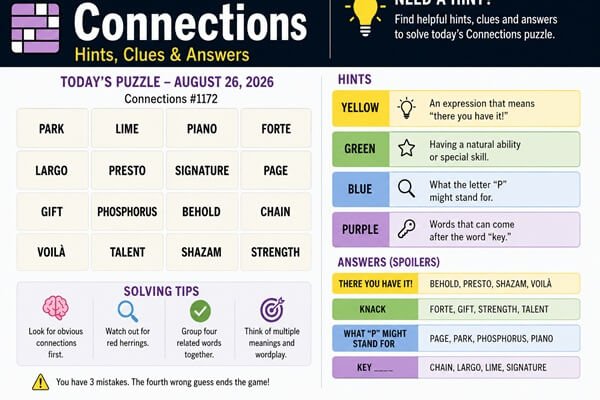
For the August 26, 2026 puzzle, Forbes lists these 16 entries:
PARK, LIME, PIANO, FORTE, LARGO, PRESTO, SIGNATURE, PAGE, GIFT, PHOSPHORUS, BEHOLD, CHAIN, VOILÀ, TALENT, SHAZAM and STRENGTH.
The hints provided by Forbes point toward four very different ideas.
The yellow clue points toward an expression meaning something like “check this out.”
The green clue concerns having a particular ability or skill.
The blue clue involves possible meanings of the letter “P.”
The purple clue points toward words that can precede “key.”
Those clues are deliberately broad.
They give you a direction without immediately handing over the solution.
That is exactly how a useful hint should work.
A Better Way to Read a Connections Hint
Don’t treat the hint as an answer.
Treat it as a search area.
Suppose the clue suggests something related to skills.
Instead of immediately looking for a category called “skills,” ask yourself which four words could describe ability, talent or natural aptitude.
That changes the way you approach the board.
You are no longer trying to guess the exact category name.
You are testing relationships.
For today’s puzzle, words such as FORTE, GIFT, STRENGTH and TALENT form the group associated with having a knack or ability. Forbes identifies that as the green category.
Once you see that group, four words disappear and the remaining puzzle becomes easier.
Today’s Yellow Connection
The yellow group is built around expressions meaning something similar to “there you have it!”
The four answers are:
BEHOLD
PRESTO
SHAZAM
VOILÀ
Forbes uses SHAZAM as its representative answer for this group and identifies the category as “there you have it!”
This is a nice example of how Connections can use words that are not strict synonyms but still share a recognizable function.
BEHOLD can introduce something being presented.
PRESTO can signal that something has suddenly appeared or been accomplished.
SHAZAM is an exclamation associated with a sudden result.
VOILÀ is commonly used when presenting or revealing something.
The connection is about the expression rather than a literal dictionary definition.
Why the Yellow Group Can Still Be Tricky
Yellow is supposed to be the easiest category, but that does not mean every word will look obvious.
Take SHAZAM.
You might immediately associate it with the music-identification app.
You might think of the comic-book character.
You might think of an exclamation.
All three associations are reasonable.
Only one matters for this particular puzzle.
That’s the core idea behind Connections.
A word can have several meanings, and the puzzle depends on you identifying the one that fits the board.
Today’s Green Connection
The green category is knack.
The four answers are:
FORTE
GIFT
STRENGTH
TALENT
Forbes identifies these as the words belonging to the green group.
This category demonstrates another common Connections technique: using words that can describe a person’s natural ability or particular strength.
FORTE is especially interesting because it can mean an area in which someone is particularly skilled.
GIFT can describe a natural ability.
TALENT is a clear example of ability.
STRENGTH can describe an area where someone performs particularly well.
Once FORTE and TALENT appear together, the rest becomes easier to test.
Today’s Blue Connection
The blue group is based on what P might stand for.
The four answers are:
PAGE
PARK
PHOSPHORUS
PIANO
Forbes identifies these as the blue category.
This is a different type of connection from the yellow and green groups.
The words themselves do not share one obvious definition.
Instead, the letter P can represent each of them in an appropriate context.
For example, P can be associated with a page.
P can be used as an abbreviation for park.
P is the chemical symbol for phosphorus.
P can represent piano in musical notation or terminology.
This is exactly the sort of category that can cause players to hesitate because the relationship is indirect.
Today’s Purple Connection
The purple group is:
CHAIN
LARGO
LIME
SIGNATURE
The connection is words that can follow “key.” Forbes identifies the category as “key _____.”
This is a classic phrase-completion category.
Keychain.
Key Largo.
Key lime.
Key signature.
The words look completely unrelated when viewed individually.
Once you place “key” before each one, the relationship becomes obvious.
This type of construction is common in Connections and is one reason the purple category can be difficult.
Why Purple Categories Cause Problems
Purple groups often require a change in perspective.
You might spend several minutes asking:
“What do these four words have in common?”
But that’s not always the right question.
Instead, try asking:
“What word can go before all four?”
Or:
“What word can come after all four?”
Or:
“Do these four create familiar phrases?”
That small change in thinking can reveal the answer.
For today’s puzzle, CHAIN, LARGO, LIME and SIGNATURE become much clearer when you add “key.”
The Red-Herring Problem
Red herrings are one of the most important parts of Connections.
They are not accidental.
The puzzle is designed to make you notice relationships that are real but not part of the intended answer.
For example, SIGNATURE could make you think about names, autographs or personal identity.
PARK could connect with many different ideas.
PIANO could make you think about music.
LARGO and FORTE also have strong musical associations.
That creates opportunities for false groups.
The correct solution depends on finding the arrangement that accounts for all 16 words cleanly.
Why Musical Words Can Be Dangerous
Today’s puzzle has several terms that look musical.
PIANO.
FORTE.
LARGO.
SIGNATURE.
PRESTO.
A player could easily start building a music category.
But that would be a mistake.
Some of these words have other intended roles.
PIANO belongs with the P group.
FORTE belongs with the knack group.
LARGO belongs with the key group.
PRESTO belongs with the “there you have it” group.
This is a perfect example of why you should never lock onto a category just because four words appear related.
The “One Away” Message Is Useful
Connections gives you feedback when a selected group is close but not quite correct.
If your selection is one word away from a valid group, the game can tell you that.
This is extremely useful.
But don’t treat it as permission to guess randomly.
Use the information logically.
If you have three words that you are confident about and one questionable word, ask which remaining entry could replace it.
That can often reveal the intended category.
Don’t Waste Your Four Mistakes
One of the biggest differences between Connections and a simple word-matching game is the limited number of mistakes.
Forbes notes that you can make three incorrect guesses, while a fourth incorrect submission ends the game.
That changes your strategy.
You should not submit every interesting combination you find.
Instead, build confidence before pressing the button.
A good rule is:
If you cannot explain why all four words belong together, don’t submit yet.
You don’t need 100% certainty.
But you should have a strong reason.
Start With the Strongest Connection
The easiest way to improve your solving is to identify the strongest relationship first.
Suppose three words are obvious synonyms.
That’s usually a good starting point.
Find the fourth.
Once that group is removed, the rest of the board becomes smaller.
The same works with proper names.
If you identify three famous people sharing a clear characteristic, look for the fourth.
The goal isn’t to solve the entire board in your head.
It’s to reduce the number of possibilities.
Use Elimination
Connections becomes much easier after one group disappears.
With 16 words, there are many possible combinations.
With 12 words, fewer.
With eight, the structure becomes much clearer.
That’s why solving one category is so valuable.
Today’s green group is a good example.
Once FORTE, GIFT, STRENGTH and TALENT are removed, the remaining words immediately make other relationships easier to see.
Don’t Ignore Unusual Words
Sometimes the strangest word is the key to the entire puzzle.
A word like SHAZAM may seem too specific.
A word like VOILÀ may seem out of place.
A word like PHOSPHORUS may seem like an obvious science clue.
Those unusual entries can actually provide the strongest starting points.
When you see a word that stands out, ask why the puzzle maker included it.
There is probably a reason.
Think About Abbreviations
Connections frequently uses abbreviations.
Today’s P category is a good example.
If a group seems impossible, consider whether the words could represent:
Letters.
Initials.
Short forms.
Symbols.
Units.
Chemical symbols.
Acronyms.
This is especially important when one word looks like it belongs to a completely different subject.
PHOSPHORUS, for example, is a science word.
But its chemical symbol creates a connection with three ordinary words in today’s grid.
Think About Prefixes and Suffixes
Another useful strategy is to add a word to the beginning or end.
Ask:
Can the same word come before these four?
Can the same word come after them?
Can the words form familiar phrases?
Today’s purple category uses exactly this technique.
Key + chain.
Key + Largo.
Key + lime.
Key + signature.
Once you train yourself to look for phrase patterns, these categories become much easier.
Connections Is About Flexible Thinking
The game rewards people who can change their interpretation quickly.
You might initially think PIANO belongs with LARGO and FORTE.
That’s understandable.
But if another group needs FORTE, you need to reconsider.
This is not a failure.
It is the actual skill the puzzle is testing.
Don’t become emotionally attached to your first theory.
Treat every category as a hypothesis.
Test it.
Keep it if it works.
Discard it if it doesn’t.
What Makes Forbes’ Guides Useful?
The main strength of the Forbes approach is its layered structure.
Instead of immediately publishing only the final answers, its guides typically move through several stages:
The rules
The word list
Category hints
One answer from each category
Category names
Complete answers
That format appears repeatedly in Forbes’ Connections coverage.
This is useful because readers can control how much help they receive.
If you’re almost finished, stop after the hints.
If you’re stuck, reveal one word.
If you’ve given up, continue to the answers.
Forbes Connections Coverage Is Not Just One Article
Another point worth understanding is that the phrase connections hint forbes doesn’t refer to one permanent page.
Forbes has published daily Connections guides across different dates and writers.
Kris Holt is a frequent author of the current weekday guides. Erik Kain and Paul Tassi have also published Connections coverage.
That means the exact article you need depends on the puzzle date.
A search should therefore include the date when possible.
For example:
Connections hint Forbes August 26 2026
is much more precise than:
Connections hint Forbes
The date prevents older puzzle results from taking over the search.
How to Find the Correct Forbes Puzzle
Connections changes every day.
If you are looking for today’s answer, check three things:
Date
Puzzle number
Day of the week
For August 26, 2026, Forbes identifies the puzzle as Connections #1172.
That number is useful because it removes ambiguity.
If two articles have similar titles, the puzzle number tells you which one is correct.
Don’t Confuse Different Years
This is particularly important when searching for Connections hints.
The same calendar date appears every year.
For example, Forbes has separate Connections articles for August 26, 2024, August 26, 2025 and August 26, 2026.
The puzzle is different each year.
So if you’re looking for today’s answer, always check the year.
An old result may still rank highly because it has accumulated links and search authority.
That doesn’t make it relevant to today’s puzzle.
How to Use Search Results More Effectively
When looking for connections hint forbes, use a specific search phrase.
Try:
Forbes Connections hint today
Forbes NYT Connections August 26 2026
Forbes Connections #1172
Connections hint today Forbes August 26
These searches are more likely to surface the current article than the short phrase alone.
The same principle works for other daily games.
Date + game name + publisher is usually a strong search combination.
Should You Read the Full Answer Immediately?
Probably not.
If you enjoy solving the puzzle, start with the category hints.
For today’s puzzle, the four broad clues are enough to make another attempt:
One group is an expression of presentation or revelation.
One group concerns ability.
One group involves meanings of P.
One group forms phrases with “key.”
That gives you plenty to work with.
Try the board again before looking at the complete answers.
The satisfaction of finding the fourth word yourself is the best part.
How to Improve Your Connections Streak
A long streak is fun, but improving your process is more important.
After every puzzle, think about the category that caused the most trouble.
Was it:
A phrase-completion category?
A celebrity category?
A wordplay category?
A technical category?
A category based on spelling?
Once you identify your weakness, you’ll start recognizing it faster.
For example, if you frequently miss categories where one word goes before four others, deliberately practice looking for phrase structures.
Build a Mental List of Common Connections
You don’t need to memorize thousands of answers.
But it helps to remember common category types.
Famous People
First names, surnames or stage names may appear separately.
Brands
Four words may be names of companies, products or brands.
Places
Cities, countries, landmarks or fictional locations can form a group.
Phrases
A common word may precede or follow all four entries.
Abbreviations
Letters may stand for different things.
Wordplay
The words may contain another word or begin with something specific.
Pop Culture
Movies, television, music and games are common sources.
Language
Synonyms, antonyms, translations and grammatical relationships can appear.
The more familiar you become with these patterns, the faster you can test possibilities.
The Importance of Reducing Ambiguity
The best Connections solvers aren’t necessarily the people who know the most facts.
They’re often the people who eliminate wrong possibilities quickly.
Suppose you see five words that could all relate to music.
You don’t need to know the entire puzzle yet.
Ask which four make the most precise group.
Then ask where the fifth word could go.
This process of elimination is more reliable than guessing based on the first association that comes to mind.
Don’t Overthink the Easy Group
Another common mistake is trying to find a complicated meaning when the category is simple.
Sometimes four words really are just synonyms.
Sometimes they really are common objects.
Sometimes the answer is sitting directly in front of you.
Connections becomes harder when players assume every category must contain a hidden trick.
Look for the obvious answer first.
If it survives the remaining board, take it.
But Don’t Trust the Obvious Group Blindly
The opposite mistake is just as dangerous.
An obvious group can be a trap.
Today’s music-related words demonstrate this.
PIANO, FORTE, LARGO, PRESTO and SIGNATURE all create musical associations.
Yet they belong to different categories.
This is exactly why the puzzle is interesting.
The connections are real.
They’re just not necessarily the connections the puzzle wants.
What Today’s Puzzle Teaches
The August 26 puzzle is a good lesson in three major Connections skills.
First, words can have multiple meanings.
Second, letters and symbols can create indirect relationships.
Third, phrases can be more important than individual word meanings.
The four groups use all three ideas.
The yellow group relies on expressions.
The green group uses meanings connected to ability.
The blue group uses what P can represent.
The purple group relies on phrase completion.
That variety is what makes the puzzle challenging.
The Full Answers for Today’s Puzzle
If you are ready for the spoilers, here is the complete solution for Connections #1172 on August 26, 2026.
Yellow — “There You Have It!”
BEHOLD, PRESTO, SHAZAM, VOILÀ
These words can function as expressions used when presenting, revealing or emphasizing a result.
Green — Knack
FORTE, GIFT, STRENGTH, TALENT
These words can describe a person’s ability or particular area of strength.
Blue — What “P” Might Stand For
PAGE, PARK, PHOSPHORUS, PIANO
The letter P can represent each of these in an appropriate context.
Purple — Key _____
CHAIN, LARGO, LIME, SIGNATURE
Each can follow the word “key”: keychain, Key Largo, key lime and key signature.
Why the Purple Group Is the Most Interesting
The purple category is probably the best example of Connections’ wordplay style.
CHAIN and LIME are ordinary words.
LARGO is associated with music.
SIGNATURE can refer to handwriting, identification or music.
At first, they seem to belong to completely different worlds.
Then the word key connects all four.
That is the moment Connections is designed to create.
You suddenly see the pattern and wonder how you didn’t notice it earlier.
A Simple Three-Step Method for Future Puzzles
You can use this approach every day.
Step One: Find the Strongest Four
Scan the board and identify the four words with the clearest relationship.
Don’t worry about solving everything.
Step Two: Remove Them Mentally
Look at the remaining 12 words.
Ask whether new relationships become visible.
Step Three: Test the Strange Ones
If one category still looks impossible, examine the unusual words.
Try prefixes, suffixes, abbreviations, names and phrase combinations.
This method is simple but surprisingly effective.
Final Thoughts on Connections Hint Forbes
The phrase connections hint forbes has become useful for players who want a little help with the daily NYT Connections puzzle without necessarily seeing the answer immediately.
Forbes’ daily format works because it gives readers several levels of assistance. The current guides begin with the basic rules and word list, move into category clues, reveal one word from each group, identify the categories and finally provide the complete answers.
That structure is worth copying when you’re trying to solve a difficult puzzle yourself.
Don’t jump straight to the answer.
Start with a broad clue.
Look for three strong words.
Find the fourth.
Remove the group.
Then attack the remaining board.
And when you see four words that appear to fit perfectly, stop for a moment.
Ask yourself whether the connection is too obvious.
That’s often where the puzzle is hiding its red herring.
For today’s August 26, 2026 puzzle, the biggest lesson is how different types of connections can appear on the same board. A phrase-based category sits beside an ability-related group, an abbreviation-style group and a phrase-completion category.
That’s why Connections remains more interesting than a simple vocabulary quiz.
You aren’t just asking what a word means.
You’re asking what else it could mean.
You’re asking what it can be paired with.
You’re asking what category it belongs to.
And most importantly, you’re asking whether the other 15 words support your theory.
Once you start thinking that way, the puzzle becomes much less about guessing and much more about solving.
Frequently Asked Questions
What does Connections hint Forbes mean?
Connections hint Forbes generally refers to Forbes’ daily guides for the New York Times Connections puzzle. These articles provide hints, category clues and eventually the full answers for each day’s puzzle.
Where can I find the Forbes Connections hint today?
Forbes publishes daily Connections hint and answer articles. Searching for the game name together with the current date or puzzle number is the easiest way to find the correct article. The August 26, 2026 puzzle is Connections #1172.
What is today’s Connections puzzle?
The August 26, 2026 Connections puzzle is #1172. Forbes lists 16 words and divides them into four categories.
What are today’s Connections answers?
The categories are “there you have it!”, knack, what P might stand for, and key _____. The complete groups are listed above in the spoiler section.
How many words are in Connections?
Each Connections puzzle contains 16 entries, which must be divided into four groups of four.
How many mistakes can you make in Connections?
You can make three incorrect guesses. A fourth incorrect guess ends the game.
Which Connections category is usually hardest?
Purple is generally considered the most difficult category, although the actual difficulty can vary from puzzle to puzzle. Purple groups often use wordplay, phrase combinations or less obvious cultural connections.
Why are some Connections words misleading?
The puzzle intentionally includes red herrings. Some words may appear to fit multiple categories, but only one arrangement is the intended solution.
Can Connections categories use abbreviations?
Yes. Today’s blue category is an example, with P representing PAGE, PARK, PHOSPHORUS and PIANO.
Can a word belong to more than one possible category?
A word can appear to fit more than one category, which is one of the main tricks used by the puzzle. The challenge is finding the combination that creates four complete groups.
How can I solve Connections faster?
Start with the strongest relationship, remove that group mentally, then examine the remaining words. When you’re stuck, look for phrases, abbreviations, names, word beginnings and word endings.
Should I look at the full answers?
Only if you want to. A good hint guide lets you stop before the spoilers. Try the category clues first and reveal the complete answers only when you are ready.
Does Forbes publish Connections hints every day?
Forbes has an established pattern of publishing daily Connections hint and answer coverage, including current weekday guides and previous articles from different contributors.
Why should I include the date when searching for Connections hints?
Because the same calendar date has a different puzzle every year. Forbes has separate Connections articles for August 26 in 2024, 2025 and 2026, for example.
Is Connections free to play?
The basic daily Connections game is available through The New York Times website and Games app. Forbes describes it as a free daily game, while some archive access is tied to NYT subscription access.
What is a Connections red herring?
A red herring is a word or combination that appears to fit a category but actually belongs somewhere else. Red herrings are one of the main ways Connections makes the puzzle challenging.
What is a reverse rainbow in Connections?
A reverse rainbow is when you solve the categories in the reverse difficulty order: purple, blue, green and yellow, without making mistakes. Forbes notes this as one of the challenges some players enjoy.