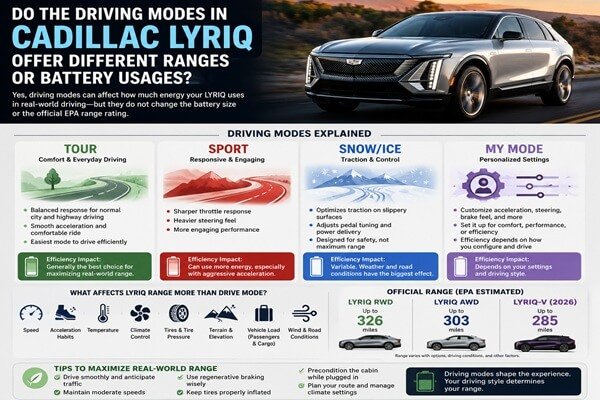
If you drive a Cadillac LYRIQ regularly, you may have noticed that the vehicle can feel very different when you switch between Tour, Sport, Snow/Ice, and My Mode. That naturally raises a practical question: do the driving modes in Cadillac LYRIQ offer different ranges or battery usages?
The short answer is yes for real-world energy consumption, but no for official range ratings or battery capacity.
Changing the driving mode does not give the LYRIQ a different-size battery. It also does not create a separate range number that Cadillac officially assigns to Tour, Sport, Snow/Ice, or My Mode. Instead, the modes change the way the vehicle responds to the accelerator, steering, braking and other systems. Those changes can affect how much electricity you use during a trip.
Cadillac’s own Driver Mode Control information describes Tour as a normal, comfortable everyday setting and Sport as a more responsive, performance-oriented setting. The LYRIQ owner’s manual also explains that Snow/Ice changes pedal tuning for slippery conditions, while My Mode allows drivers to customize several vehicle responses.
That distinction is important because several online articles make very specific claims such as Sport mode reducing range by 10%, 20%, 30 miles or even more. After reviewing the leading search results for this topic, there is no Cadillac-published mode-by-mode EPA range table supporting a universal percentage like that. Some articles do make such claims, but they should be treated as real-world anecdotes or estimates rather than official LYRIQ specifications.
So what actually happens when you change modes? Let’s break it down.
The Simple Answer: Mode Changes Behavior, Not Battery Size
Think of the LYRIQ’s battery as a fixed tank of electrical energy.
Selecting Tour does not make the tank larger.
Selecting Sport does not make the tank smaller.
Selecting Snow/Ice does not add a winter reserve.
Selecting My Mode does not unlock extra battery capacity.
What changes is how the vehicle uses the energy available in that battery.
Cadillac’s owner documentation describes Driver Mode Control as a system that adjusts the overall driving experience. The available modes can vary according to model, trim, region and equipment. For the LYRIQ, the documented modes include Tour, Sport, Snow/Ice and My Mode.
This means that two LYRIQ drivers could start with the same battery percentage and finish a journey with different amounts of energy remaining even if they selected different modes.
But the difference would not necessarily be caused by the mode alone.
Driving style matters enormously.
If Sport mode makes one driver accelerate harder, that driver will probably use more electricity. If another driver selects Sport but drives smoothly at a steady speed, the difference may be relatively small.
That is why it is misleading to say that Sport mode automatically removes a fixed percentage of LYRIQ range.
Do Cadillac LYRIQ Driving Modes Have Different Official Ranges?
No.
Cadillac does not publish separate EPA range ratings for Tour, Sport, Snow/Ice and My Mode.
The official range figure is associated with the vehicle configuration.
For example, Cadillac currently lists the LYRIQ with EPA-estimated range figures that vary according to drivetrain configuration. Cadillac’s current information lists up to 326 miles for a rear-wheel-drive LYRIQ and up to 303 miles for an all-wheel-drive version on its preceding-year information.
Those numbers should not be interpreted as:
- Tour = 326 miles
- Sport = 280 miles
- Snow/Ice = 300 miles
- My Mode = 310 miles
That is not how the rating works.
The EPA figure is based on the vehicle configuration and standardized testing. It is not a separate official measurement for every selectable driving mode.
This is one of the most important points to understand when researching Cadillac LYRIQ driving modes range battery usage.
Why Different LYRIQs Have Different Range Ratings
If you see two LYRIQ models with different advertised ranges, look at the vehicle configuration first.
Factors can include:
- Rear-wheel drive versus all-wheel drive
- Model year
- Wheels and tires
- Vehicle equipment
- Performance configuration
- Battery and powertrain specifications
The 2026 LYRIQ-V is an especially good example.
Cadillac lists the LYRIQ-V with a 102-kWh usable battery and a Cadillac-estimated range of 285 miles. It is a dual-motor AWD performance SUV with substantially more power than the regular LYRIQ.
That lower range is a vehicle-configuration difference, not a result of simply switching a standard LYRIQ from Tour to Sport.
What Actually Changes When You Select a Driving Mode?
A driving mode is better understood as a group of vehicle settings.
Cadillac’s LYRIQ owner manual explains that different modes can modify several vehicle systems.
Depending on the configuration, these can include:
- Accelerator or pedal response
- Steering feel
- Brake feel
- Suspension tuning
- Electric vehicle sound enhancement
- Adaptive cruise behavior
- Electric all-wheel-drive behavior
- Traction-related settings
The result is a different driving experience.
The battery itself remains the same.
That distinction helps explain why driving modes can influence real-world battery usage without having their own official range ratings.
Tour Mode: The Sensible Everyday Choice
Tour is the mode most drivers will probably use most often.
Cadillac describes Tour as being intended for normal city and motorway driving and says it provides a smooth balance between comfort and handling.
Cadillac’s general Driver Mode Control guide similarly describes Tour as providing normal acceleration and comfortable ride tuning for everyday driving.
Tour isn’t necessarily a special “battery-saving” mode in the way some EVs have a dedicated Eco setting.
Instead, its more relaxed and predictable response makes it easier to drive smoothly.
And smooth driving is important for EV efficiency.
Imagine two drivers leaving the same traffic light.
Driver A gently accelerates and reaches the speed limit.
Driver B presses the accelerator hard, reaches the speed limit quickly, brakes for traffic and then accelerates hard again.
Even if both vehicles are in Tour mode, Driver B is likely to use more energy.
This shows why mode selection is only one part of the efficiency equation.
Also read: The Flying Elephant Memoirs of an Olympic Champion: Alexander Savin’s Story
Is Tour the Best LYRIQ Mode for Maximum Range?
If your priority is everyday efficiency, Tour is the most logical default.
But it is not correct to promise that Tour will always produce the maximum possible range.
Your speed, weather, tires, road conditions, terrain, heating or air conditioning and driving style can easily outweigh the effect of the mode.
A smooth driver in Sport could potentially use less energy than an aggressive driver in Tour.
That’s why there is no universal answer such as:
Tour always gives exactly X more miles.
Cadillac does not publish such a number.
Sport Mode: Does It Use More Battery?
Sport mode is where the question becomes more interesting.
Cadillac describes Sport as providing a more controlled and sporty response. On the LYRIQ, Sport can modify steering effort, pedal tuning, electric vehicle sound enhancement, adaptive cruise control and suspension tuning when equipped.
The biggest practical issue for range is what happens with your right foot.
Sport makes the vehicle feel more responsive.
That can encourage stronger acceleration.
And stronger acceleration requires more electrical power.
If you repeatedly take advantage of the LYRIQ’s instant electric torque, the battery will naturally discharge faster.
But there is an important difference between power consumption and mode-specific efficiency.
Sport doesn’t necessarily mean the car is constantly wasting electricity simply because the word “Sport” appears on the screen.
If you select Sport and then cruise smoothly at a steady speed, you are not suddenly using a huge amount of extra energy just because of the mode.
The bigger difference comes when the mode changes your driving behavior.
Does Sport Mode Reduce LYRIQ Range by 10% or 20%?
You will find claims online that Sport mode can reduce LYRIQ range by 10%, 20%, 30 miles or even more.
Some of the articles appearing in search results make exact numerical claims. For example, one article says Sport mode can reduce range by 10–20%, while another suggests a 30–60-mile difference depending on conditions.
The problem is that these numbers are not official Cadillac figures.
Cadillac does not provide a standard statement saying:
“Sport mode reduces LYRIQ range by 20%.”
Without a controlled test, such a number is not universally applicable.
A real-world comparison would need to control:
- Starting battery percentage
- Outside temperature
- Battery temperature
- Wind
- Road surface
- Route
- Traffic
- Average speed
- Acceleration
- Tire pressure
- Wheel and tire configuration
- Climate-control settings
- Vehicle load
- Elevation changes
Change any of those and the result can change.
So it is better to say:
Sport mode can increase energy consumption when its sharper response leads to more aggressive driving.
That statement is supported by how the mode works and does not invent a fixed range penalty.
Snow/Ice Mode Is Not an Economy Mode
Snow/Ice mode can cause confusion because it changes the way power is delivered.
Cadillac’s LYRIQ owner manual says Snow/Ice mode adjusts pedal tuning to optimize traction on slippery surfaces. It also modifies electric all-wheel drive and steering where applicable.
The goal is not to give you the longest possible range.
The goal is to help the vehicle behave more predictably when grip is limited.
That can mean softer or more controlled power delivery.
In some situations, smoother torque delivery can help prevent unnecessary wheelspin.
But you should not think:
Snow/Ice = battery-saving mode.
That’s not its purpose.
Winter Weather Can Matter More Than Snow/Ice Mode
This is one of the most important points for LYRIQ owners.
If you see a major range drop during winter, don’t automatically blame Snow/Ice mode.
Cold weather itself can affect EV range.
You may also use more cabin heat.
Roads may be wet or covered with snow.
Winter tires can have different rolling characteristics.
Snow and slush increase resistance.
Wind and temperature can also change efficiency.
Cadillac itself warns that actual range varies with factors including temperature, terrain, battery age, loading, use and maintenance.
So if your LYRIQ normally shows a high range estimate and then drops noticeably during a cold winter trip, the weather may be much more important than the selected driving mode.
My Mode: The Most Flexible Setting
My Mode is different because it lets the driver create a personalized setup.
Cadillac’s owner manual says My Mode can allow customization of settings including:
- Acceleration feel
- Brake feel
- Steering
- Suspension
- Motor sound
The exact availability depends on vehicle content.
That means there isn’t really one thing called My Mode efficiency.
One person could create a relaxed setup.
Another could configure a more aggressive driving feel.
Two LYRIQ owners could therefore use My Mode differently and see different energy consumption.
Can My Mode Be Used for Better Efficiency?
Potentially, yes, but there is no guarantee.
If you configure a calmer acceleration response and combine that with smooth driving, you may find it easier to control energy use.
But My Mode isn’t a magic range extender.
The same driver can configure My Mode aggressively and use more energy.
Think of it as a personalization feature rather than a dedicated economy setting.
Does Regenerative Braking Change the Answer?
Yes, regenerative braking is an important part of the conversation.
Electric vehicles can recover some energy when slowing down.
Instead of relying entirely on friction brakes, the electric motor can operate as a generator and send some energy back toward the battery.
The LYRIQ offers regenerative-driving features, including Regen on Demand and One-Pedal Driving. Cadillac’s LYRIQ materials describe these systems as ways to recover energy during deceleration.
But regeneration doesn’t create free energy.
If you accelerate hard and then brake heavily, you cannot recover all of the electricity used to accelerate.
Some energy is lost during the conversion process.
That’s why efficient EV driving is not about:
Accelerate hard → regenerate → repeat.
A more efficient approach is:
Accelerate smoothly → maintain speed → anticipate traffic → slow gradually.
Regeneration then becomes a useful way to recover some energy that would otherwise be lost.
Does One-Pedal Driving Increase LYRIQ Range?
One-Pedal Driving can be useful, particularly in traffic where you’re repeatedly slowing down.
Instead of constantly moving between accelerator and brake, you can use the accelerator to control speed and allow regenerative deceleration to recover energy when slowing.
However, it does not automatically guarantee a specific range increase.
Your overall driving pattern still matters.
On a city route with frequent traffic lights, regeneration can be useful.
On a highway where you’re maintaining a steady speed for long periods, there may be fewer opportunities to recover energy because you’re not repeatedly slowing down.
Cadillac also notes that regenerative and one-pedal functions can be limited under certain conditions, including very cold or hot battery temperatures and when the battery is near full.
Speed Usually Matters More Than Drive Mode
If you’re trying to maximize LYRIQ range, don’t obsess over the mode selector while ignoring speed.
Aerodynamic drag increases significantly as speed rises.
That means a highway trip at a substantially higher speed can use considerably more energy than a slower trip, even if both trips are made in Tour.
This is why someone could switch from Sport to Tour and see little improvement if they continue driving at high speeds.
Meanwhile, another driver could keep Sport selected but drive calmly and efficiently.
The mode matters.
But it is only one variable.
Climate Control Can Also Affect Battery Usage
The LYRIQ uses electricity for more than propulsion.
The climate system also consumes energy.
Heating can be particularly important in cold weather.
Air conditioning can also affect efficiency, especially during shorter journeys or very hot conditions.
If you are trying to understand why your battery usage changed from one day to another, check the climate system before blaming the driving mode.
For example:
Day 1: Mild temperature, moderate speed, little HVAC use.
Day 2: Very hot weather, strong air conditioning, heavy traffic.
Even if both trips are made in Tour, the energy consumption can be noticeably different.
Tires and Wheels Matter Too
Tires have a direct relationship with rolling resistance.
Tire pressure matters as well.
An underinflated tire can increase rolling resistance and reduce efficiency.
Wheel and tire configurations can also contribute to different official range figures between vehicle configurations.
So if you’re comparing two LYRIQs, don’t assume the difference is caused by driving mode.
Check the complete vehicle specification.
Terrain Changes Battery Usage
A flat road and a mountainous route are not equivalent.
Climbing requires additional energy.
Descending can recover some energy through regeneration, but not all of the energy used to climb can be recovered.
That’s another reason a single trip isn’t enough to determine whether one driving mode is more efficient.
A Sport-mode trip on a flat highway could produce a different result from a Tour-mode trip through steep hills.
The route itself can be more important than the setting.
Vehicle Load Also Matters
A heavily loaded LYRIQ requires more energy to accelerate than a lightly loaded one.
Passengers, luggage and other cargo all add weight.
That doesn’t mean you need to travel with an empty vehicle to maximize range.
It simply means that real-world efficiency depends on the entire driving situation.
This is why laboratory range numbers should never be interpreted as guaranteed mileage for every trip.
Why the LYRIQ’s Range Estimate Can Change
One of the most confusing things for EV owners is the estimated range shown on the dashboard.
You may start with an estimate of 300 miles.
Then drive aggressively for a while.
The displayed estimate might fall faster than expected.
That doesn’t mean the battery suddenly lost physical capacity.
The vehicle is estimating how far it can travel based on energy consumption and operating conditions.
If your recent driving uses more energy per mile, the predicted remaining distance can change.
This is why switching to Tour may sometimes appear to “increase” range later.
The battery has not magically gained energy.
The estimate is responding to your driving pattern.
Battery Percentage Is More Useful Than Guessing From Range
If you’re testing different driving modes, don’t rely only on the displayed range.
Instead, record:
- Starting battery percentage
- Ending battery percentage
- Distance traveled
- Average speed
- Outside temperature
- Climate-control use
- Driving mode
- Route
- Energy efficiency
If your LYRIQ provides energy-use information, use those readings as well.
Then repeat the test.
One trip doesn’t prove much.
Five similar trips can tell you considerably more.
How to Properly Test Tour vs Sport
If you’re curious about the actual difference in your own LYRIQ, you can perform a simple controlled comparison.
Step 1: Choose a repeatable route
Use the same road and similar traffic conditions whenever possible.
Step 2: Start with a similar battery percentage
You don’t need to start at 100% every time.
A similar starting point is enough.
Step 3: Keep climate settings consistent
Don’t test Tour with the air conditioning off and Sport with it running at maximum.
Step 4: Keep your speed similar
Speed is one of the biggest variables.
Step 5: Record the energy used
Write down the distance and battery percentage used.
Step 6: Repeat the test
Do not make a conclusion after one trip.
Weather and traffic can easily distort the result.
This approach is far more useful than accepting an online claim that Sport automatically costs 20% of your range.
A Practical Comparison of LYRIQ Driving Modes
| Driving Mode | Main Purpose | Possible Battery-Use Effect | Best Use |
|---|---|---|---|
| Tour | Smooth everyday driving | Generally the easiest setting for efficient driving | Daily driving and road trips |
| Sport | More responsive performance | Can increase consumption when used for harder acceleration | Dry roads and spirited driving |
| Snow/Ice | Traction and controlled acceleration | Variable; prioritizes grip rather than maximum range | Snow and slippery roads |
| My Mode | Personal customization | Depends on chosen settings and driving style | Drivers who want a customized setup |
The table should be read as a practical guide, not as an official Cadillac range comparison. Cadillac does not publish a fixed EPA mileage figure for each of these modes.
What About the LYRIQ-V?
The LYRIQ-V deserves separate attention because it is not simply a standard LYRIQ with a Sport button.
Cadillac describes the 2026 LYRIQ-V as a high-performance electric SUV with a 102-kWh usable battery, dual-motor AWD and up to 615 horsepower in its performance setting. Cadillac estimates 285 miles of range for the model.
It also has performance-specific features such as V-Mode, Competitive Mode and Velocity Max.
That is different from the standard LYRIQ’s everyday drive modes.
In particular, Cadillac explicitly documents the performance-oriented nature of LYRIQ-V features. This makes it even more important not to mix information about the LYRIQ-V with information about the regular LYRIQ.
A statement about maximum-performance operation on the LYRIQ-V should not automatically be applied to every standard LYRIQ.
Does Sport Mode Damage the LYRIQ Battery?
Using Sport mode normally is not the same thing as damaging the battery.
The LYRIQ is designed to provide performance.
Selecting Sport is part of normal vehicle operation.
What Sport can do is make high-power acceleration easier and more tempting.
That means you can use more electricity during spirited driving.
But energy consumption and battery damage are two different questions.
Drivers should still follow Cadillac’s operating and charging recommendations and pay attention to vehicle warnings.
Does Tour Mode Charge the Battery Faster?
No.
This is another misconception worth clearing up.
Driving modes control how the vehicle behaves while driving.
They do not turn the battery into a different charging configuration.
Charging speed depends on the charging equipment, battery condition, temperature, state of charge and vehicle configuration.
Cadillac’s LYRIQ-V specifications, for example, list different AC charging rates and DC fast-charging performance, demonstrating that charging speed is a separate issue from selecting a normal driving mode.
So selecting Tour isn’t a trick for faster charging.
Does Snow/Ice Mode Save Battery?
Not as its primary purpose.
Snow/Ice exists to improve control and traction on slippery surfaces.
Cadillac specifically says that the mode adjusts pedal tuning for traction and can modify electric all-wheel-drive and steering behavior.
If smoother torque delivery prevents wheelspin, it may avoid wasting some energy.
But the conditions that cause you to use Snow/Ice—cold weather, snow, slush and poor road conditions—can themselves reduce efficiency.
So don’t select Snow/Ice because you expect more miles.
Select it because the road conditions require better traction behavior.
What Affects LYRIQ Range More Than Driving Mode?
If range is your main concern, pay attention to these factors first:
1. Speed
Higher speeds generally require more energy because aerodynamic resistance increases.
2. Acceleration
Repeated hard acceleration can quickly increase energy consumption.
3. Temperature
Cold and very hot conditions can affect EV efficiency.
4. Climate Control
Heating and cooling use electricity.
5. Tires
Tire pressure and tire characteristics influence rolling resistance.
6. Terrain
Hills require additional energy.
7. Vehicle Load
More weight can increase energy use.
8. Traffic
Repeated acceleration and braking can reduce efficiency.
9. Wind
Strong headwinds can significantly increase aerodynamic resistance.
10. Battery Temperature
Battery temperature can influence charging and regenerative functions.
Cadillac specifically states that actual range varies according to factors including temperature, terrain, battery age, loading, use and maintenance.
Which LYRIQ Mode Should You Use for Daily Driving?
For most drivers, Tour is the easiest recommendation.
It provides a comfortable and predictable driving response and is designed for everyday use.
But you don’t need to avoid Sport.
If you enjoy Sport mode, use it when appropriate.
The key is understanding the trade-off.
If you use Sport and take advantage of the sharper response, expect your efficiency to depend on how aggressively you drive.
There is nothing wrong with using more energy when you want more performance.
That’s part of why the mode exists.
Which Mode Is Best for a Long Road Trip?
Tour is generally the sensible starting point for a long trip when range and comfort are priorities.
But route planning matters more than the mode selector.
Before a long journey, consider:
- Charging locations
- Weather
- Highway speed
- Traffic
- Elevation
- Passenger and cargo load
- Tire pressure
- Expected HVAC use
A well-planned route in Sport could be easier than an inefficient route in Tour.
Don’t sacrifice safe driving or comfort simply to chase a theoretical range advantage.
Which Mode Is Best in Snow?
Use Snow/Ice when road conditions require it.
Cadillac designed the mode specifically to adjust acceleration and traction behavior for slippery surfaces.
Do not choose Tour simply because you think it will save a few miles if the road is genuinely slippery.
Traction and control are more important than squeezing out a small theoretical efficiency improvement.
Can a Smooth Sport-Mode Driver Beat an Aggressive Tour-Mode Driver?
Absolutely.
This is perhaps the easiest way to understand the entire issue.
Imagine:
Driver A: Tour mode, hard acceleration, frequent braking, high speed.
Driver B: Sport mode, smooth acceleration, steady speed, careful braking.
Driver B could easily achieve better energy efficiency.
Why?
Because the mode doesn’t control every aspect of how the driver operates the car.
The mode influences vehicle response.
The driver controls the accelerator.
That’s why claims that one mode always gives a certain percentage more range should be treated carefully.
The Best Way to Think About LYRIQ Drive Modes
Instead of thinking:
Tour = long range
Sport = short range
Snow/Ice = medium range
My Mode = unknown
Think about them like this:
Tour = balanced everyday response
Sport = performance-oriented response
Snow/Ice = traction-oriented response
My Mode = personalized response
The energy result depends on what happens after you select the mode.
That is a much more accurate way to understand the LYRIQ.
Final Verdict
So, do the driving modes in Cadillac LYRIQ offer different ranges or battery usages?
The most accurate answer is:
They can affect real-world battery usage and therefore real-world range, but they do not have separate official range ratings and they do not change the physical capacity of the battery.
Tour is the sensible everyday choice if you want a smooth, predictable driving experience.
Sport makes the LYRIQ feel more responsive and can lead to higher electricity consumption when you use that response for aggressive acceleration.
Snow/Ice is designed for traction and controlled power delivery rather than maximum range.
My Mode gives you the freedom to customize the vehicle, so its energy consumption depends on your settings and driving style.
And the LYRIQ-V is a separate performance-focused model with its own powertrain, battery and range characteristics. Cadillac rates the 2026 LYRIQ-V at 285 miles of estimated range with a 102-kWh usable battery.
The biggest lesson is that the driving mode is only one piece of the range equation.
Speed, acceleration, temperature, terrain, tires, climate control, wind, traffic and vehicle load can all have a major impact.
So if you’re trying to get the most miles from your Cadillac LYRIQ, don’t worry about avoiding Sport mode forever.
Instead, focus on the things that actually consume energy.
Drive smoothly.
Keep speeds reasonable.
Avoid unnecessary acceleration and braking.
Keep your tires properly inflated.
Use regenerative braking intelligently.
Pay attention to weather.
And compare your actual efficiency over several similar trips instead of judging the car from a single range estimate.
That approach will tell you much more about your LYRIQ than any fixed claim that Sport mode costs exactly 10%, 20% or 30% of your range.
Frequently Asked Questions
Does changing the Cadillac LYRIQ driving mode change the battery size?
No. Selecting Tour, Sport, Snow/Ice or My Mode does not physically change the battery capacity.
Does Sport mode reduce LYRIQ range?
It can reduce real-world efficiency when the sharper response leads to harder or more frequent acceleration. Cadillac does not publish a universal percentage range penalty for Sport mode.
Is Tour mode the best mode for LYRIQ range?
Tour is a sensible default for smooth everyday driving, but actual range depends on many factors beyond the selected mode.
Does Snow/Ice mode save battery?
Not specifically. Snow/Ice is designed primarily to improve traction and control on slippery roads.
Does My Mode improve LYRIQ range?
Not automatically. My Mode can be configured in different ways, so its energy consumption depends on the selected settings and how you drive.
Does regenerative braking increase LYRIQ range?
Regenerative braking can recover some energy during deceleration, helping reduce energy that would otherwise be lost through friction braking. It does not recover all of the energy used to accelerate.
Is One-Pedal Driving more efficient?
It can be useful in stop-and-go driving because it allows regenerative deceleration, but the overall efficiency benefit depends on the route and driving style.
Does the 2026 LYRIQ have a 102-kWh battery?
Cadillac’s 2026 LYRIQ-V specifications list a 102-kWh usable battery. Battery and range specifications can vary by model and configuration, so buyers should check the exact vehicle specification.
What is the maximum range of the 2026 Cadillac LYRIQ?
Cadillac’s current information lists up to 326 miles of EPA-estimated range for a rear-wheel-drive LYRIQ, with lower estimates for other configurations.
What is the range of the LYRIQ-V?
Cadillac lists the 2026 LYRIQ-V at an estimated 285 miles of range.
Does Sport mode damage the battery?
Normal use of Sport mode is part of the vehicle’s intended operation. It can increase energy consumption when you use the additional performance, but selecting Sport itself should not be confused with battery damage.
Does Tour mode charge the battery faster?
No. Driving mode and charging speed are separate systems.
What affects LYRIQ range the most?
Speed, temperature, terrain, acceleration, HVAC use, tires, wind, traffic, vehicle load and battery conditions can all affect real-world range. Cadillac specifically notes temperature, terrain, battery age, loading, use and maintenance among the factors that affect actual range.
1 thought on “Do the Driving Modes in Cadillac LYRIQ Offer Different Ranges or Battery Usages?”